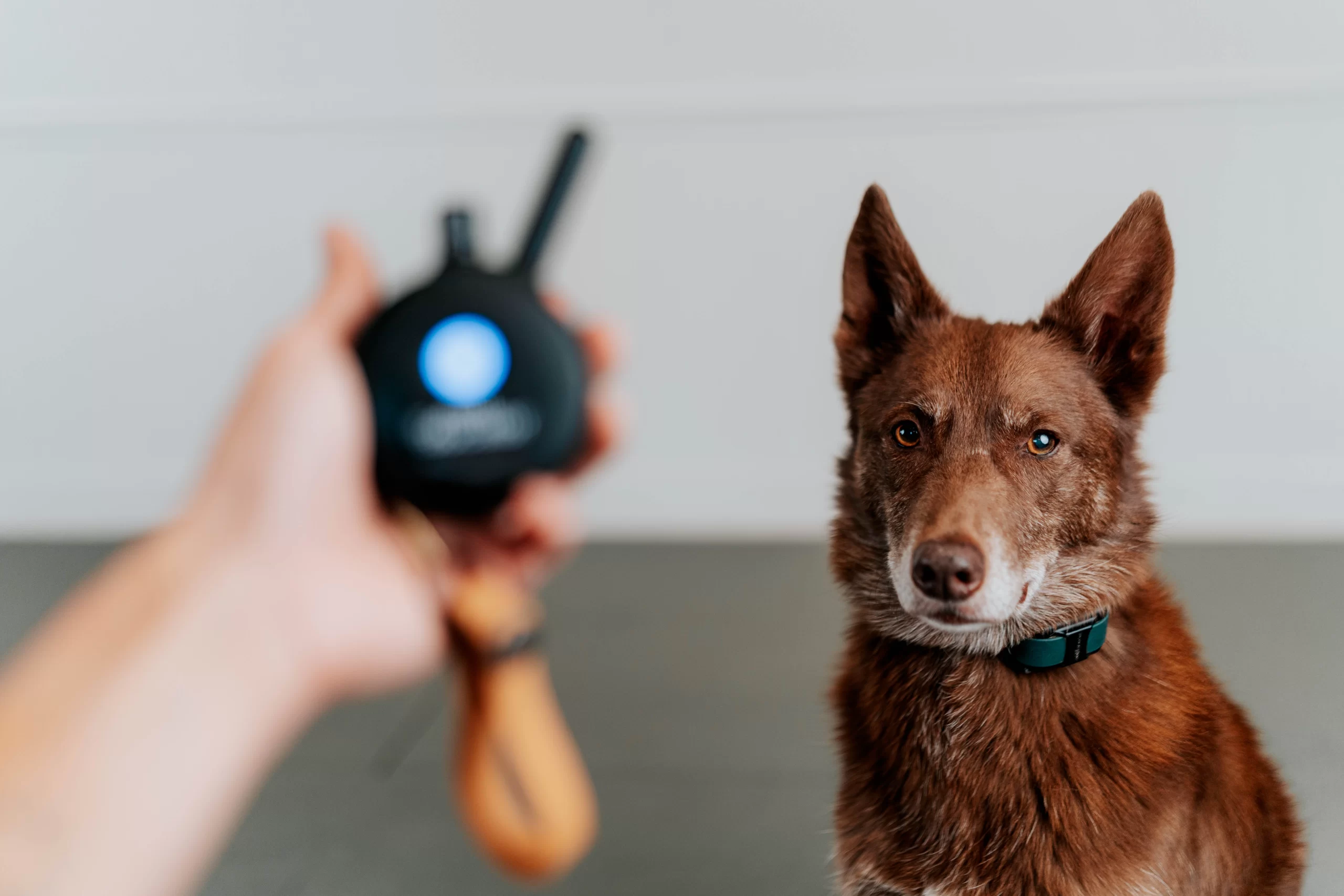
The Honest Truth About E-Collars
If you search “are shock collars1 cruel,” you’ll find page after page of advocacy content from animal welfare organizations, veterinary associations, and rescue groups; almost all of it written from a firm “anti-shock collar” position.
What you won’t find much of is a working dog trainer giving you an honest, balanced answer that actually engages with the concerns rather than dismissing them.
The conversation about e-collar safety deserves more nuance than most of what’s currently out there on either side. I use e-collars in my dog training, and I also believe they can cause harm when used incorrectly.
What The Research Actually Says
The honest answer is that the research on e-collar safety is genuinely mixed, and anyone who tells you it’s settled in one direction or the other hasn’t engaged carefully with the full body of evidence.
The studies most frequently cited by critics of aversive training methods are real, peer-reviewed, and worth taking seriously.
Schilder and van der Borg (2004) observed German Shepherd Dogs being shocked as punishment corrections during protection sport training and found that previously shocked dogs showed more stress behaviors even in sessions where no shocks were delivered, suggesting the dog training environment itself had become associated with the aversive experience.
Cooper et al. (2014), the largest study in this space, found that dogs trained with shock collars showed more stress-related behaviors than dogs trained with reward-based methods, and that shock collar use produced no superior obedience outcomes.
Vieira de Castro et al. (2020) found elevated stress indicators and more pessimistic cognitive bias in shock collar-trained dogs compared to reward-trained dogs.
These findings matter, and they can’t be dismissed by pointing out that they involved “inexperienced” handlers or poor methodology – just look at the Cooper el al. (2014) study, which used industry-approved e-collar trainers.
But I also think that engaging honestly with the research means acknowledging what it doesn’t tell us.

The most instructive study in this entire literature is Schalke et al. (2007) is worth understanding in detail because it keeps getting cited by both sides of the training spectrum, often without anyone explaining what it actually found.
In this study, the researchers divided laboratory beagles into three groups and used electric shock in different ways:
- One group received stimulation precisely when they touched a prey object: they could clearly predict and control it.
- A second group received stimulation when they failed to return on a recall command: they could clearly predict and control it because they understood the recall cue.
- A third group was shocked randomly with no way to predict or avoid it.
The results were striking.
The randomly shocked group showed the highest increased cortisol levels, and the group shocked with precise, predictable pairing to their behavior showed the smallest increase.
The conclusion that runs through the subsequent literature citing this study is consistent: it is unpredictability, * not stimulation itself *, that drives the welfare harm. When a dog clearly understands what behavior produces the consequence and has reliable control over the outcome, physiological stress indicators are dramatically lower.
This finding has significant implications for animal welfare. It suggests that the welfare outcome of e-collar use is determined primarily by how it’s applied – specifically, whether the dog has a clear, consistent behavioral pathway to avoid or turn off the stimulation.
A more recent study, Johnson and Wynne (2024)2, compared e-collar training to reward-based methods for stopping high-drive chase behavior and found that e-collar trained dogs stopped chasing within one to two sessions while reward-only dogs failed to stop chasing across all training and test sessions.
The animal welfare assessment found few stress-related behaviors in the e-collar group.
This brings us to the most important gap in the entire research base, and one that the literature itself acknowledges: the vast majority of studies examined high-level corrective use, protection sport training, or laboratory conditions that don’t reflect how modern e-collar dog training is actually practiced by educated handlers working with companion dogs.
The Cooper study used approved trainers, which matters, but “industry approved” in 2014 covers a wide range of practices, and none of these studies examine the specific training method this post describes: low-level working stimulation, introduced gradually, after solid foundational training, within a training system where the dog has clear agency over the outcome.
That gap means the research doesn’t cleanly support the conclusion that responsible modern use of e-collars is harmful. It also means the research doesn’t cleanly absolve it.
What it does tell us, clearly and consistently, is that predictability, timing, and the dog’s ability to control the outcome are the variables that determine animal welfare outcomes. Build a dog training system around those principles, and the evidence suggests the welfare picture looks very different from what the most-cited studies document.
The Questions People Are Actually Asking
Do E-Collars Hurt Dogs?
The answer depends entirely on the level being used, and understanding that requires knowing how a properly applied shock collar system actually works.
Responsible e-collar dog training uses three distinct stimulation levels, each serving a different purpose.
- The conditioning level is the lowest level a dog can just barely perceive, often described as a tap on the shoulder. It’s not meant to interrupt behavior or demand the dog’s attention. It’s used early in training to build the association between the sensation and a known cue, pairing it with leash guidance, voice cues, and rewards. At this level, the dog is learning that the sensation has meaning – nothing more.
- The working level is a step up from conditioning, intentionally more noticeable, and enough to get the dog’s attention and prompt follow-through on a behavior they already understand. For most dogs this is the sweet spot: they feel it, they notice it, and they know what to do.
- The correction level (sometimes called a boost level) is a deliberately higher level used when a dog is in a heightened state of arousal and ignoring a known cue. Think chasing wildlife, or a situation escalating toward a safety risk. This level, typically 10 to 20 points above the working level, isn’t about punishment. It’s about interruption – a pattern break that brings the dog out of tunnel vision and back into a thinking state. It’s used sparingly, in specific circumstances, and always followed by calm re-engagement and reward when the dog makes the right choice.
At conditioning and working levels (where the vast majority of training happens) no, e-collars do not hurt dogs. The sensation is perceptible but not painful. At correction levels used in high-stakes moments, there is a stronger physical sensation by design. And at high levels used carelessly, repeatedly, or as a default…yes, that can cause real pain and potentially cause harm.
Level selection is not incidental to e-collar safety. It is e-collar safety. A system that never progresses beyond working level for routine training, uses correction level sparingly and appropriately, and treats high stimulation as a last resort is a fundamentally different tool than the one critics are describing when they argue against the use of “shock collars”.

Are E-Collars Cruel?
Cruelty requires intent to cause suffering, or a reckless disregard for it. By that standard, responsible e-collar training, introduced gradually, at working level, within a system where the dog has clear agency and earns rewards for correct behavior is not cruel. But let’s go deeper than a definition, because this question deserves a more honest answer than a semantic argument.
Training [real training] doesn’t happen in a vacuum. And, it rarely happens without some form of discomfort or stress along the way.
Think about how a child learns not to touch a hot stove. The parent says don’t touch it. The child touches it anyway. The pain is immediate, unambiguous, and proportionate. The lesson sticks, permanently, after a single experience, in a way that no amount of verbal warning ever could. Was that moment uncomfortable? Absolutely. Did it cause lasting physical and emotional harm? No. Did it damage the child’s relationship with their parents? No. It was a clear consequence, directly linked to a behavior, that the child could understand and that kept them safe from that point forward. In addition, the child completely understands why they received the burn and how to avoid it next time, so they aren’t afraid of the stove either.
Nature works exactly the same way. Watch a mother dog with a litter of puppies around feeding time. She doesn’t give an elaborate explanation of personal space. She gives a low warning growl as the puppy approaches her with her food. If the puppy ignores it, she growls again – louder and stiffens up her body as a cue to stay away. If the puppy keeps pushing, she delivers a quick, sharp nip. The puppy yelps…and then, it recovers. Quickly. Because the communication was fair, immediate, and understandable. The puppy wasn’t confused about why it happened, and it wasn’t traumatized. It wasn’t permanently afraid of its mother, and the relationship was intact five minutes later. What the puppy learned is that giving space around food is important. From that one point on it waits patiently until the mother moves away. No ongoing management required. No repeated reminders. Just a lesson absorbed.
This is how animals actually communicate with each other. Consequences exist: they’re immediate, proportionate, and they make sense within the context they’re delivered.
The e-collar, used responsibly, operates on exactly this principle with one important addition that nature doesn’t always offer: the handler has precise control over the intensity.
At conditioning and working levels, we’re not talking about corrections at all. We’re talking about subtle, low-level communication the equivalent of a shoulder nudge. A tap that says pay attention, or I need you with me right now. Not startling, not painful, just noticeable.
The correction level [used sparingly, in high-arousal situations where a dog is genuinely tuning out a known cue] is closer to the mother dog’s nip. It’s meant to interrupt, not to punish. It’s stronger by design because the situation requires it. Just like the puppy with its mother, a properly prepared dog who understands what the sensation means and how to respond to it can recover quickly. Because the communication was fair, timely, and understandable.
So, the welfare concern with e-collars isn’t simply that the e-collar exists, its all about consequences delivered without context…when a dog has no way to predict them, understand them, or turn them off through their own behavior.
A device used carelessly on an undertrained pet deserves the criticism it gets…but an e-collar used within a clear, consistent, reward-heavy system where the stimulation is proportionate, the dog has a reliable off-switch, and every correct response is rewarded, is not cruelty. It’s communication. And in many cases, it’s the most humane thing you can do for a dog who needs reliable guidance to stay safe in the real world.
Can E-Collars Cause Psychological Harm?
Yes, under specific conditions. Being honest about what those conditions are is more useful than either dismissing the concern or using it to condemn the tool entirely.
The research is actually quite clear on the mechanism. Schalke et al. (2007) tested three groups of dogs who received stimulation in different contexts: one group where the shock was precisely paired with a specific behavior they could control, one group where the pairing was less clear, and one group where it was delivered randomly with no predictable connection to anything the dog did.
The results were consistent: the randomly shocked group showed the highest physiological stress indicators and increased cortisol levels. The group with the clearest behavioral association showed the lowest. The conclusion that researchers on both sides of this debate keep returning to is the same: it is unpredictability and inescapability that cause harm, not stimulation itself.
Think about what that actually means. A dog who receives stimulation they can’t predict, can’t understand, and can’t turn off through their own behavior is in a genuinely distressing situation. There is no pattern in their behavior to learn from, and no action that reliably makes it stop. The experience is arbitrary and inescapable, and that combination is documented to cause fear, stress, and in serious cases, learned helplessness. That is a real animal welfare problem and it deserves to be named as one.
But the same research tells us that when a dog clearly understands what behavior is being asked, has been conditioned to recognize what the stimulation means, and has a reliable off-switch through their own correct response, the picture looks fundamentally different. The communication loop is complete, the dog isn’t confused, and the stimulation isn’t arbitrary. It’s providing tactile feedback in a language they’ve already been taught, asking them to do something they already know how to do.

This is why the foundational training requirement isn’t a recommendation that can be skipped when you’re in a hurry. It’s the thing that separates ethical e-collar use from harmful e-collar use.
A dog who has a clear marker word, understands the recall cue, knows what a correct response earns, and has been gradually introduced to the device as an extension of an existing communication system…that dog has the framework to interpret stimulation clearly. Nothing about the experience is unpredictable or inescapable, and they know exactly what to do to make it stop. More importantly, after enough repetitions, they’ve learned to respond before it starts at all.
That’s avoidance conditioning working exactly as intended, and a dog in that state isn’t experiencing anxiety. They’re experiencing clarity. Those are very different things, and conflating them does a disservice to the real welfare concerns the research identifies.
The psychological harm risk is real, but understanding that it’s also almost entirely a function of how the tool is used, not of the tool’s existence, is important. Unpredictable timing, no behavioral pathway out, use on pets who don’t have the foundational understanding to make sense of the experience – those are the conditions that produce harm. Remove those conditions and the mechanism for harm disappears.
So, the honest answer isn’t “shock collars can cause psychological harm” as a standalone statement. It’s: “e-collars used without proper foundation, timing, and predictability can cause psychological harm,” and that risk is exactly what responsible dog training methodology is designed to eliminate…and this is why I believe that education around the tool rather than tool shaming and ‘mysticism’ is so important. The more educated an owner is when they pick up this tool, the more likely they will use it properly and fairly.
The Case For Measured Discomfort
There’s a broader principle worth naming here, because it reframes the entire safety conversation in a way that’s more honest than how it usually gets discussed.
We accept mild, temporary pain in animal care all the time when the benefit clearly outweighs it. Vaccines cause a moment of physical discomfort. Post-surgery recovery is genuinely painful. Keeping a high-energy dog on leash when they desperately want to run is frustrating for them in a real and immediate way. We don’t describe any of those things as cruel because the pain is proportionate, brief, and clearly in the animal’s long-term interest. The discomfort is the cost of the benefit, and we accept that cost because the alternative is worse.
The same logic applies to e-collar dog training in high-stakes situations. And this is where the case for the tool becomes hardest to argue against honestly.
For many pets, particularly lower-drive companion breeds with a natural inclination toward their handler, off-leash reliability can be built without a “shock collar.” Those dogs exist, and for them, the tool may genuinely be unnecessary. But for high-drive dogs, hunting dogs, working dogs, independent breeds, or dogs whose recall needs to hold up in genuinely dangerous situations, reward-based methods alone often hit a ceiling that no amount of additional training fully breaks through.

A 2024 study from Arizona State University (Johnson and Wynne) illustrated this directly. Dogs with high-drive chase behavior were trained with either an e-collar or reward-only-based methods. E-collar trained dogs stopped chasing within one to two sessions and held that behavior across subsequent tests. Reward-only animals failed to stop chasing across every single training session and every test. The limitation wasn’t the effort or the expertise, it was the ceiling that reward-based methods hit when competing against a deeply ingrained, self-reinforcing drive behavior.
Consider what that finding means in a real-world context.
A dog with strong prey drive who has learned to chase deer, squirrels, cyclists, other animals (etc), is a dog whose safety cannot be guaranteed off leash. But, a well-timed correction level stim that interrupts that chase doesn’t just address a training problem, it could prevent a collision with a car, a dog getting lost in terrain they can’t navigate back from, or a confrontation with wildlife that fights back. The pain of the correction (which in this case would be at a higher ‘boost’ level) lasts a fraction of a second. The outcome it prevents could be catastrophic and permanent.
I’ve made this calculation with my own dogs. Introducing the e-collar correctly, at low levels, within a system they already understood, is a small price to pay for the quality of life they have now. Have I used the boost level? Absolutely, but – I could count those moments on two hands. A handful of uncomfortable moments over a lifetime to prevent what could be a catastrophic event for my dog? This isn’t cruel, this is parenting. It is my job to guide my dogs so they understand what is safe and what is not, and having precise control over the intensity is what makes that guidance fair. Off-leash trails, freedom to move, the ability to be out in the world without constant restriction. That freedom doesn’t exist without the reliability that backs it up.
I want to be clear, this is not a justification for casual or punitive use. It’s a recognition that in certain dog training contexts like off-leash reliability, and recall in high-distraction or genuinely high-stakes environments, a correctly applied e-collar stim isn’t just acceptable, it’s arguably the more humane choice compared to the alternative: a dog who lives their entire life on a 6ft leash because their safety can’t be trusted, or a dog whose recall fails at the moment it matters most.
Working trainers who use e-collars aren’t making a compromise when they reach for this tool, and this tool is far from what some would call a “short-cut” in training. They’re making a considered judgment that a dog with solid, e-collar-backed reliability has a higher quality of life and more freedom than dogs without it, and a higher margin of safety than a dog without it. The goal has always been more freedom, not less.
What “Safe” Actually Requires
E-collar safety isn’t a property of the device, it’s a property of the system it’s used in. A quality e-collar in educated hands produces one outcome. The same collar in uneducated hands produces another. Here’s what the system needs to include for the tool to be used responsibly in canine training.
Foundation First, Always!
Before an e-collar is introduced, the dog needs a clear communication system already in place, and that includes a solid understanding of the specific behavior you plan to layer the collar onto. If you intend to use the e-collar with a recall cue, your dog needs to already know what “come” means, what the finished behavior looks like, and how to execute it successfully. That behavior is built first through positive reinforcement, with consistent repetitions that create a clear, positive association before any tool enters the picture.
Beyond the specific behavior, the broader foundation needs to be in place too. That means a solid marker word, treat delivery skills, and a genuine understanding that feedback means “try something different” and correct behavior earns reward. Without this foundation, the dog has no framework to interpret what the stimulation means. The device goes on after [and only after] the language is already built, never before. A dog who doesn’t understand the marker word, doesn’t have a conditioned cue, or hasn’t been introduced to basic leash communication is not ready for the e-collar layer regardless of their age or breed.
Find The Conditioning Level Before Anything Else.
The first time the tool is used, the only goal is finding the lowest level the dog can just barely perceive, what we call the conditioning level. This isn’t the level you train at. It’s the level you start at, to build the initial association between the sensation and the dog training system. Starting at the lowest setting and moving up one level at a time until you see the first subtle flicker of recognition like an ear twitch, a slight head turn, or a shift in the dog’s attention is non-negotiable. That recognition, not anything that looks like a startle or a flinch, is what you’re looking for.
Wear The Device Before it’s Ever Activated.
The collar should be worn for several sessions before the stimulation is ever used. The pet should associate wearing it with good things such as walks, play, and training rewards. The physical experience of wearing the device should be neutral to positive before it carries any communicative meaning.

Understand All 3 Levels & Use Them Appropriately.
Once the conditioning level is established, training moves to the working level which is intentionally more noticeable, enough to get the dog’s attention and prompt follow-through on a behavior they already know. The correction or boost level [higher still] is used sparingly in high-arousal situations, and is reserved for genuine safety moments involving bad behaviour or dangerous situations, not routine training. These three levels are distinct tools within the same system, and treating them as interchangeable is how the system breaks down.
Timing Has To Be Right!
The stimulation must be directly paired with the behavior it’s addressing, not delivered a second later, and absolutely not used as a general expression of frustration. Poor timing is one of the primary mechanisms through which “shock collar” training causes confusion and stress. When the connection between behavior and consequence is unclear, or the dog has no reliable way to make it stop, you cause confusion and stress.
Keep The Reward Rate High Throughout Training.
E-collar dog training is not a replacement for positive reinforcement. It operates alongside it. For every piece of feedback the device delivers, there should be an immediate, clear reward when the dog responds correctly. The ratio of positive to corrective interactions should be heavily weighted toward positive always. A training session that is mostly corrections and rarely rewards is not responsible e-collar use. It’s a sign that something in the foundation needs to be rebuilt.
Address Unwanted Behaviors Through Understanding, Not Just Correction.
E-collar training is most effective when it’s used to reinforce a behavior the dog already understands, not as a tool to suppress behaviors whose root cause hasn’t been addressed. A dog that barks compulsively, displays aggression, or engages in unwanted behaviours driven by anxiety or frustration needs that underlying issue addressed first. The device should never be the first response to a behavioral problem.
Know When To Use It!
A dog with significant fear-based behavior is not a candidate for e-collar training at any level, regardless of how carefully the training method is followed. Adding a training device that functions as an aversive to a dog already operating from a fear state risks compounding the problem rather than solving it. The foundation has to include emotional stability before any aversive tool is appropriate.
When all of these conditions are in place, the e-collar functions exactly as it was designed to: as a precise, low-level communication tool that gives the handler a way to follow through clearly and the dog a way to understand exactly what’s being asked. Remove any one of these conditions and the system starts to break down. Remove several of them and you’re no longer doing e-collar training, you’re doing something that deserves the criticism it gets.
Who E-Collar Training is Not Right For
Part of using this tool responsibly is being honest about when it isn’t appropriate, and what humane dog training actually looks like in practice. The goal isn’t to convince everyone to use a “shock collar,” it’s to make sure that when someone does, the conditions are right for it to actually work and for the dog to be treated fairly.
Dogs With Significant, Fear, Anxiety, or Aggression.
A fearful dog is already operating from a state of heightened stress. Adding a training device that functions as an aversive to a dog in that state doesn’t just risk compounding the problem, it actively undermines the mechanism the tool depends on.
E-collar training works because the dog can make a clear behavioral association: this sensation means something specific, and I can turn it off by responding correctly.
An aggressive dog or fearful dog flooded with fear doesn’t have the cognitive bandwidth to make that association. The stimulation becomes just more noise in an already overwhelming experience.
These pets need confidence-building work first, often with qualified in-person support, before any aversive tool belongs in the picture. Attempting to address aggression or fearful behavior with aversive methods without proper expert guidance can make behavioural problems significantly worse.
Dogs Under 6 Months Old.
Puppies under six months are still developing neurologically and emotionally. Their nervous systems are still forming and their stress responses are less stable. The foundational training they need before the e-collar is layered in simply takes time to build, and there is no benefit to rushing it.
Honestly, for most owners I wouldn’t recommend e-collar training until at least twelve months old. Six months is the hard floor, but the reality is that most owners haven’t built a strong enough foundation by then for the collar to be introduced fairly. We cover this in full in our dedicated post on when to start e-collar training.
Dogs Having a Moment of Genuine Panic.
Even a well-trained dog with a solid e-collar foundation shouldn’t have the device used during genuine panic: a severe thunderstorm, a traumatic encounter, a situation where the dog is already completely overwhelmed. The same principle applies: a dog in that state can’t make the behavioral association the tool depends on. The correction level is designed for high-arousal training moments where the dog has the capacity to respond and recover. It is not for dogs who are already past the point of being able to think clearly. Knowing the difference matters.
Dogs Whose Handlers Aren’t Ready To Learn How To Properly Apply The E-Collar.
This isn’t about gatekeeping, it’s about being honest that the tool requires real investment to use well.
Understanding working levels, timing, foundational conditioning, when to use each of the three stimulation levels, and how to read your dog’s responses…none of that is complicated, but all of it matters. A “shock collar” in the hands of someone who skips the introduction, defaults to high levels, or applies it inconsistently is going to cause problems regardless of how good the device is.
The commitment to learning the system has to come before the collar goes on. Expert guidance from a qualified trainer before starting can make the difference between a tool that transforms your dog’s reliability and one that causes physical or emotional harm.
The Bigger Picture
The e-collar debate has spent decades stuck in a false binary: “humane positive training” on one side, “cruel aversive training” on the other. That framing doesn’t serve pets, and it doesn’t serve the people who are genuinely trying to make good decisions for them.
The honest picture is more complicated than either side tends to acknowledge. The research identifies real welfare risks, and those risks deserve to be taken seriously, not dismissed. Unpredictable, high-level, poorly timed use of a “shock collar” causes measurable harm. That’s documented and it’s real.
But the same research, most clearly in Schalke et al. (2007) and in the more recent Johnson and Wynne (2024) findings, also show that predictability, clear behavioral association, and the dog’s ability to control the outcome change that picture significantly. The tool isn’t the variable. The training method is.

The dogs that benefit most from e-collar training are often the ones who would otherwise spend their lives restricted and frustrated. High-drive working breeds with strong independent instincts. Pets whose recall fails in the environments where it matters most. Dogs who need the kind of clear, distance communication that voice cues alone can’t reliably provide when the environment is competing at full volume. For those dogs, done right, e-collar training isn’t the cruel option. It’s often the most humane option – the one that gives them the most freedom, and the most safety.
The goal of responsible, humane e-collar use for dogs of all drives and temperaments has never been to find a quick fix or to avoid doing the harder work of building a foundation. In the long run, a dog trained with proper e-collar methodology, is a dog with more freedom, more reliability, and a stronger relationship with their handler than a dog managed through avoidance and restriction alone.
That doesn’t mean it’s right for every dog, every handler, or every situation. It means the question “are e-collars safe?” has a real answer: yes, within a specific set of conditions, applied by someone who understands the training method. No, when those conditions aren’t met.
Explore the Canine Gains Curriculum
Get the FREE Download for the E-Collar Essentials Mini eBook HERE!
The Canine Gains curriculum has never been about selling anyone on a “shock collar,” It’s about making sure that if you choose to use one with your dogs, you have the knowledge, the foundation, and the system to do it right. That starts with the Free Foundations Course [the prerequisite for everything else] and builds through the Basic Voice-Only Recall Course before the Advanced E-Collar Recall Bundle ever enters the picture. In that sequence, the tool lands in the right place: last, on top of a foundation that makes it fair.
Frequently Asked Questions About E-Collar and Shock Collar Safety
What do veterinary associations say about shock collars?
The American Veterinary Society of Animal Behavior (AVSAB) – the leading veterinary association on companion animal behavior in the United States – and several other veterinary associations and professional bodies, including the International Association of Animal Behavior Consultants, have issued position statements recommending against the use of “punishment-based” tools including shock collars as a first-line dog training approach. Their position prioritizes positive reinforcement methods and reward-based training as the preferred standard of care.
It’s worth understanding what these positions are based on and what they aren’t. Most cite the same body of peer-reviewed research discussed in this post, and many veterinary associations acknowledge that the existing literature has significant gaps, particularly around low-level, methodologically sound e-collar use. A professional body recommending against a tool in general practice is not the same as demonstrating that responsible use of that tool causes harm. These are institutional risk-management positions, not clinical verdicts. That said, if your veterinarian or a veterinary behaviorist has assessed your individual dog and recommended against aversive training methods, that guidance deserves serious weight.
Are invisible fences safer than shock collars for dog training?
An invisible fence uses the same basic mechanism as remote training collars [electrical stimulation delivered via collar] but with one critical difference: the dog has no handler controlling the timing, level, or context of the shock. The device fires automatically when the dog approaches the boundary, regardless of what the dog is doing, what state they’re in, or whether they have any way to make sense of the experience.
Many invisible fences also have training guides that are required when you first set up the fence. It’s important that you don’t skip this step of acclimating your dog to the set boundary so they understand what causes the stim, how to turn it off, and how to avoid triggering it in the future.
The invisible fence carries specific risks that remote training collars don’t. They don’t prevent other animals or strangers from entering the yard. A dog in high-arousal pursuit of prey or in a fearful state may blow through the boundary and then be unwilling to re-enter the yard due to the pain associated with crossing back. These are documented behavioral problems that emerge from the use of invisible fences, and they’re worth factoring in before choosing this option over other training methods.
Can shock collars cause aggression in dogs?
Yes, under specific conditions. The mechanism is well documented. When aversive tools are used on dogs who are already in a fear or stress state, the aversive stimulus can become associated with the trigger – the other dog, person, or situation – rather than with the dog’s own behavior. The result is a dog who becomes more reactive and more aggressive toward the trigger, not less. This is one of the clearest documented negative effects of poorly applied aversive training methods on dog behavior.
This is not an argument against responsible e-collar use. It’s an argument for never applying aversive training techniques to an aggressive dog without expert guidance and a thorough behavioral assessment first. An aggressive dog needs the root cause of the aggression identified and addressed, not a tool layered on top of it.
Aggression driven by fear is worsened by punishment. Aggression driven by resource guarding, territorial behavior, or redirected frustration each have distinct profiles that require different approaches. Using a shock collar as a quick fix for aggression without understanding that profile is how aversive methods produce the harm the research documents.
What is positive punishment and how does it relate to e-collar training?
In behavioral science, positive punishment means adding something to decrease a behavior: the “positive” refers to addition, not pleasantness. An electric stimulation that stops a dog from chasing is one example. So is a leash correction, a verbal reprimand, or a squirt of water. Most dog training methods, including those practiced by trainers who don’t use e-collars, include some form of consequence delivery, even if they don’t use that terminology.
The distinction that actually matters isn’t which category the technique falls into, but whether it’s applied with the precision, timing, and contextual clarity that makes it informative rather than distressing. An e-collar used at working level, within a clear system of reward and feedback, with an immediate off-switch the dog controls…that is a fundamentally different tool than high-level, random, or poorly timed corrections. Both may involve aversive stimuli, but they do not produce the same outcomes.
What is negative reinforcement and does e-collar training use it?
Negative reinforcement means removing something to increase a behavior: the dog does the right thing, and the aversive stimulus stops. In responsible e-collar dog training, this is exactly the mechanism at work in avoidance conditioning: continuous stimulation at a low level begins, and stops the moment the dog responds with the correct behavior. The sensation ending is the reinforcement, and it’s one of the most powerful principles in animal behavior science when applied with clarity and timing.
Critics of aversive training sometimes object to this principle on ethical grounds. But again, what determines the ethics is the intensity of the stimulus, the clarity of the behavioral pathway, and the dog’s ability to reliably control the outcome. Done correctly, avoidance conditioning produces dogs who respond reliably before the sensation ever starts because they’ve learned how to avoid it entirely. This is canine training working exactly as intended.
Can shock collars cause physical harm or injury?
Yes, but not from the stim itself. The most commonly documented physical risks associated with the use of e-collars involve contact “burns” on the neck from prolonged collar wear, allergies to the metal or plastic of the contact points, skin irritation from wet or dirty contact points, and rubbing caused by a collar that is too loose.
Contact burns, sometimes called pressure necrosis, are the most commonly documented form of physical injury associated with e-collar use, and they’re almost entirely preventable through proper collar fit and rotation.
The contact points should be positioned to avoid bony prominences, the collar should fit snugly enough to maintain consistent contact without applying constant pressure to the neck, and it should be removed after each training session. A collar left on for extended periods, especially on a dog who is active or wet, creates the conditions for skin injury regardless of whether stimulation is used. This isn’t unique to shock collars – any collar worn improperly for extended periods can cause neck irritation.
There is no peer-reviewed evidence that correctly applied e-collar training at working levels causes brain damage, nerve damage, or internal injury. Claims to that effect circulate in some advocacy contexts but are not supported by the research literature.
Do shock collars work for barking?
Automatic bark collars are a distinct product category from remote training collars, and they carry the specific welfare risks that come with any automatic aversive device: the dog can’t always make a clear behavioral association, the timing can misfire, and the root cause of the barking is rarely addressed.
If a dog barks from fear, separation distress, boredom, or territorial reactivity, suppressing the bark with an automatic shock collar doesn’t treat the underlying problem. The barking may stop temporarily, and it may return in another form, or the dog’s behavior may worsen in ways that aren’t immediately obvious.
Remote training collars used by a handler to address barking in specific training contexts are a different application entirely. A handler who uses a collar to interrupt nuisance barking at the moment it starts, pairs it with a redirect to an incompatible behavior, and rewards the dog for settling is using the tool within a training framework that addresses behavior rather than just suppressing it.
Barking driven by bad behaviour habits rather than emotional distress responds reasonably well to this approach. Barking driven by anxiety, fear, or frustration requires the emotional state to be addressed first, not suppressed. Knowing the difference is what determines whether the tool helps or makes things worse.
Are electronic collars and remote training collars the same thing?
The terms electronic collars, remote training collars, e-collars, and shock collars all refer to the same category of training devices: tools that deliver electrical stimulation to the dog via a collar and receiver unit, controlled by a remote transmitter.
The terminology varies primarily by context and connotation. “Electronic collars” and “remote training collars” tend to be used by trainers and manufacturers. “Shock collars” is the term most commonly used in welfare advocacy because it elicits a desired negative emotional response to the tool. “E-collar” is the shorthand preferred in the professional training community.
Within the category, there are meaningful differences in quality, range, and precision of stimulation levels. Canine training devices from reputable manufacturers offer a wide range of stimulation levels – typically 1 to 100 – with enough granularity to find the precise threshold for each individual dog.
Lower-quality devices offer fewer levels, less precise stimulation, and less consistent performance. The quality of the training device matters, both for welfare outcomes and for training effectiveness. A collar that delivers inconsistent stimulation undermines the precise timing and predictability that responsible methodology depends on.
Should I use positive reinforcement methods only, or can I combine them with e-collar training?
This is ultimately your decision as an owner, and it should be an informed one.
What’s worth understanding first is that life doesn’t happen in a vacuum. Dogs live in a world full of real consequences, some natural, some social, some environmental. A dog who runs into traffic, gets into a fight, or chases wildlife into dangerous terrain doesn’t get a do-over. The question isn’t whether consequences exist in your dog’s life. They do, whether you introduce them intentionally or not. The question is whether the consequences your dog experiences are predictable, fair, and ones they can learn from.
The framing of “positive reinforcement only versus aversive training” is a false binary, and one the research doesn’t actually support. If you want to understand the full picture of how dogs learn and why consequences matter in both directions, our post on operant conditioning and the four quadrants of learning is worth reading before you make this decision. [Link to four quadrants post]
What the research does support is this: aversive methods used without a positive reinforcement foundation, without clear behavioral associations, and without a reliable reward system already in place produce worse outcomes across welfare and behavior measures. The problem isn’t the consequence. It’s the absence of the foundation that makes the consequence meaningful rather than distressing.
The most effective approach for most dogs, and the one described throughout this post, uses positive reinforcement as the primary language and introduces the e-collar as an extension of that existing communication system, not a replacement for it. The reward rate stays high. The reinforcement history is deep. The collar is the final layering tool, not the first option.
The choice is yours. But it’s worth making it with a clear understanding of what actually makes the difference between a system that works and one that doesn’t.
Is the e-collar an excellent tool for every dog?
The short answer is Yes. When applied correctly, the e-collar is a communication tool and can be applied appropriately and fairly to any dog. But does every dog require the layering of the e-collar? No.
For lower-drive companion dogs who respond readily to reward-based training and don’t face the kind of high-stakes off-leash demands that test the ceiling of positive reinforcement methods, the e-collar may offer little benefit that a well-built leash training and recall foundation doesn’t already provide. The idea that every dog needs an e-collar is as mistaken as the idea that no dog can benefit from one.
Where the tool genuinely shines, and where it becomes an excellent tool for the right dogs in the right hands, is with high-drive dogs, working breeds, hunting dogs with strong prey instincts, or any dog whose recall needs to hold up reliably in genuinely dangerous environments. These are the dogs for whom a properly introduced shock collar creates a meaningful quality of life improvement: the ability to be off leash safely, with a communication system that holds up when it matters most.
What should I focus on before using a shock collar?
Focus on the foundation first. The single most important thing you can do before introducing any remote training collar is to build a training system your dog already understands and trusts. That means a conditioned marker word, behavioral cues that have been practiced, rewarded, and proofed at gradually increasing levels of distraction, and it means your dog understands that feedback during training is information, not threat, and that correct responses are always worth making.
Without that foundation, the e-collar has no behavioral framework to attach to, but with a strong foundation, it becomes an extension of a language the dog already speaks.
Footnotes
- A quick note on terminology before we go further. You’ll see both “shock collar” and “e-collar” used throughout this post, and the distinction matters. The term “shock collar” typically refers to earlier-generation devices: basic, blunt instruments with limited adjustability and few precision settings, often used for correction-based punishment. The e-collar is the modern iteration: an electronically sophisticated training device with a wide range of precisely calibrated stimulation levels (typically 1 to 100) designed for communication at working levels rather than punishment. When critics document harm, they are most often describing the misuse of shock collars or the misapplication of e-collars. When responsible trainers talk about what they use and recommend, they are talking about e-collars specifically. That distinction runs through everything in this post. ↩︎
- It’s worth noting criticisms that apply to this study: the reward-based protocol was not implemented with the level of incremental distraction proofing an experienced positive reinforcement trainer would use. And the shock collar protocol, while following correction and boost level practices, was also not implemented with the full foundational conditioning and gradual introduction that responsible trainers recommend. Both sides of that comparison have legitimate methodological questions…which is why it’s important to remember that scientific studies happen in a vacuum where real life does not. ↩︎
References
Cooper, J.J., Cracknell, N., Hardiman, J., Wright, H., & Mills, D. (2014). The welfare consequences and efficacy of training pet dogs with remote electronic training collars in comparison to reward based training. PLOS ONE, 9(9), e102722. https://journals.plos.org/plosone/article?id=10.1371/journal.pone.0102722Johnson, A.C., & Wynne, C.D.L. (2024). Comparison of the efficacy and welfare of different training methods in stopping chasing behavior in dogs. Animals, 14(18), 2632. https://pmc.ncbi.nlm.nih.gov/articles/PMC11428818/Schalke, E., Stichnoth, J., Ott, S., & Jones-Baade, R. (2007). Clinical signs caused by the use of electric training collars on dogs in everyday life situations. Applied Animal Behaviour Science, 105(4), 369-380.Schilder, M.B.H., & van der Borg, J.A.M. (2004). Training dogs with help of the shock collar: short and long term behavioural effects. Applied Animal Behaviour Science, 85(3-4), 319-334.Vieira de Castro, A.C., Fuchs, D., Morello, G.M., Pastur, S., de Sousa, L., & Olsson, I.A.S. (2020). Does training method matter? Evidence for the negative impact of aversive-based methods on companion dog welfare. PLOS ONE, 15(12), e0225023.